
India's Tyre Exports Hit Record High in FY26
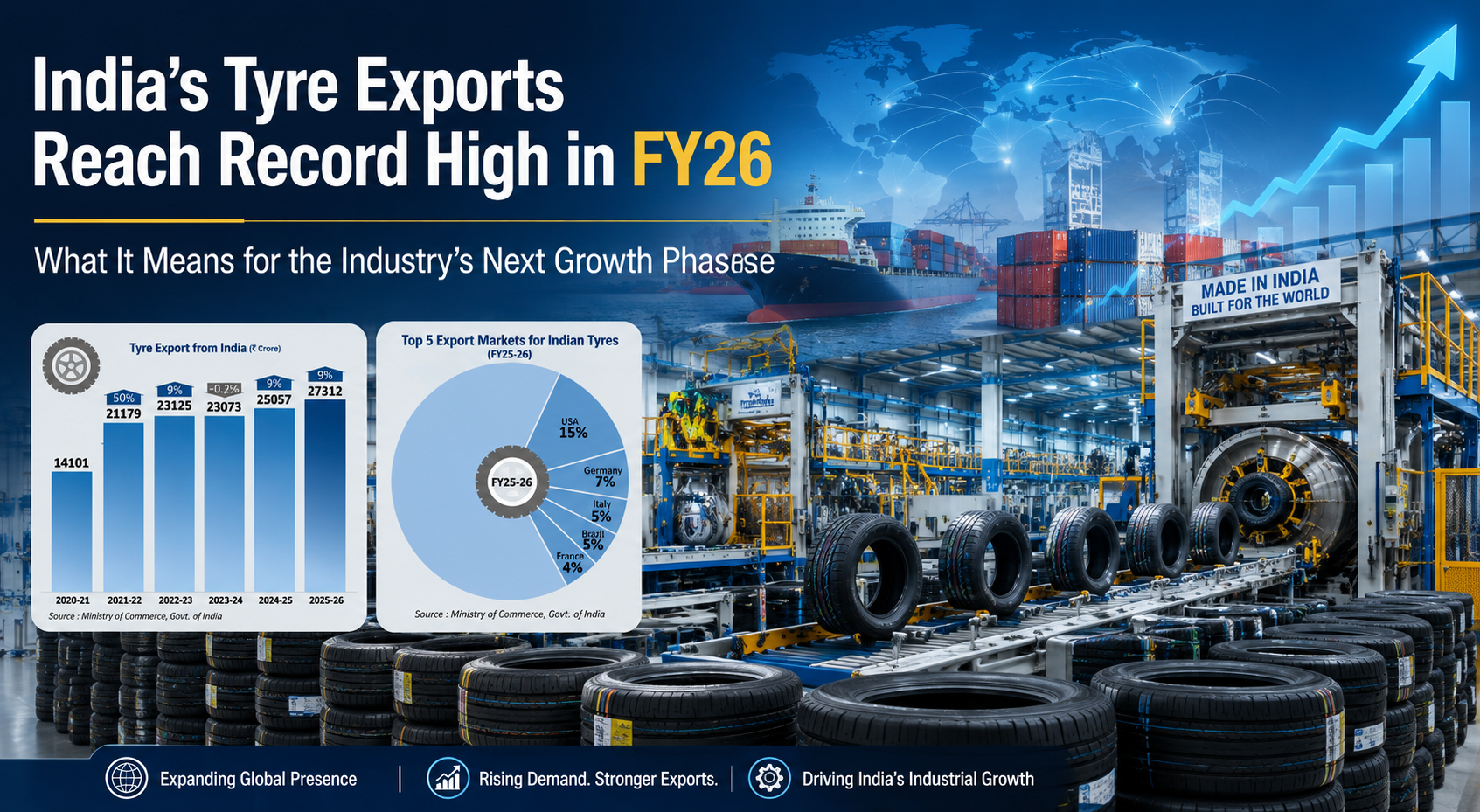
India’s tyre exports just hit an all-time high in FY2025–26, pulling in ₹27,312 crore. That’s a 9% jump over last year—and it’s the second year in a row the numbers have grown like this, according to the Automotive Tyre Manufacturers Association (ATMA).
This steady growth reflects the strengthening global position of Indian tyre manufacturers, even in a challenging international environment shaped by geopolitical tensions, trade uncertainties, and fluctuating demand in key export markets.
But let’s look past the milestone. This export growth points to something bigger: the tyre industry in India is shifting into full expansion mode. It’s building capacity and setting the stage for deeper global integration.
Exports Keep Rising, Even with Challenges
One of the most notable aspects of FY26 performance is that export growth has continued despite external pressures such as:
- • Trade policy fluctuations, including tariff-related challenges in major markets
- • Global geopolitical instability affecting logistics and shipping
- • Uneven demand recovery across Europe and North America
- • Rising input and freight costs
Despite these conditions, Indian tyre exports have not only remained stable but have grown consistently for two consecutive years at around 9% CAGR (YoY growth basis).
This indicates that Indian manufacturers have improved their global competitiveness in terms of:
- • Product quality consistency
- • Cost efficiency in production
- • Supply chain reliability
- • Diversified export market presence
India’s Tyre Export Network Expands Across 170+ Countries
Tyres from India now travel to more than 170 countries. The United States remains the largest export destination, accounting for approximately 15% of India’s tyre exports followed by Germany, Italy, Brazil, and France.
This diversified export base reduces dependency on any single geography and strengthens long-term industry resilience. It also reflects a major shift: India is no longer just a domestic consumption-driven tyre market; it is becoming a globally integrated manufacturing and export hub.
Investment Momentum in Capacity Expansion
To support growing demand, the Indian tyre industry has already invested approximately ₹30,000 crore over the past 4–5 years in capacity expansion projects, including both greenfield and brownfield developments.
However, despite these investments, demand continues to outpace supply in several segments. This is driven by:
- • Rising domestic vehicle production
- • Increasing replacement tyre demand
- • Growth in commercial and industrial vehicle usage
- • Expansion in global OEM sourcing from India
- • Entry into higher-value tyre segments (radial, specialty, off-highway tyres)
The result is a continuous requirement for capacity augmentation across the sector.
Why Export Growth Is Structurally Significant
The current export performance is not a short-term cycle-driven spike. Instead, it reflects a structural transformation in global sourcing strategies.
1. Shift in Global Supply Chains
Many global buyers are actively diversifying sourcing away from single-country dependency strategies.
India benefits directly from this shift due to its:
- • Competitive manufacturing base
- • Skilled engineering ecosystem
- • Established tyre manufacturing clusters
2. Strong Manufacturing Cost Advantage
India continues to offer a cost-efficient production environment compared to many developed economies, without compromising quality standards.
3. Increasing Product Capability
Indian manufacturers are expanding capabilities in:
- • Passenger car tyres
- • Truck and bus radial tyres
- • Off-the-road (OTR) tyres
- • Specialty industrial tyres
This diversification is improving export competitiveness.
Domestic Demand Adds a Strong Second Growth Engine
While exports are growing steadily, domestic demand remains equally strong.
Key domestic demand drivers include:
- • Expansion of logistics and transportation sector
- • Infrastructure and construction activity
- • Mining and industrial growth
- • Rising vehicle ownership and mobility demand
- • Strong replacement cycle in commercial tyres
This dual demand structure—domestic + export—creates one of the most stable industrial growth environments in the manufacturing sector.
Manufacturing Capacity Gap: The Emerging Opportunity Area
Despite strong investment activity, the industry continues to face a capacity gap in certain segments, especially in:
- • High-performance radial tyres
- • Large truck and bus tyres
- • Specialty and industrial tyres
- • Export-grade premium products
This gap is creating a natural requirement for:
- • New manufacturing units
- • Brownfield expansion of existing plants
- • Technology upgradation of legacy facilities
- • Process optimization for higher output efficiency
From an industry planning perspective, this phase is typically associated with long-term capital investment cycles and structured manufacturing expansion.
Why Tyre Manufacturing Is Becoming a Strategic Industrial Sector
Tyre manufacturing is increasingly being viewed as a strategic sector due to:
- • High integration with automotive and infrastructure industries
- • Strong export potential
- • Long product lifecycle demand (replacement market stability)
- • Continuous technology evolution
- • Increasing global quality standards compliance
However, it is also a capital- and expertise-intensive industry, requiring careful planning in:
- • Plant layout and engineering
- • Machinery selection
- • Raw material strategy
- • Production efficiency optimization
- • Quality control systems
- • Workforce training and plant operations
Industry Insight: Expansion Requires Engineering-Led Planning
As the industry enters a capacity expansion phase, successful outcomes depend heavily on technical and operational planning rather than just capital investment.
Key success factors include:
- • Efficient plant design and material flow
- • Proper selection of production technology
- • Optimization of energy and raw material consumption
- • Scalable production architecture
- • Quality consistency systems aligned with global OEM standards
This is where structured industrial consultancy and engineering expertise play an important role in ensuring long-term operational efficiency.
Conclusion: A Strong Growth Cycle for India’s Tyre Industry
India’s record tyre export performance of ₹27,312 crore in FY26, along with 9% YoY growth for two consecutive years, clearly indicates that the industry is in a strong expansion phase.
With exports reaching over 170 countries and leading markets like the US contributing around 15% share, the industry is becoming more globally integrated and competitive.
Combined with robust domestic demand and approximately ₹30,000 crore in recent capacity expansion investments, the sector is clearly positioned for continued growth.
The current phase can be summarized as:
A transition from stable growth to structured capacity expansion and global manufacturing integration.
For industry stakeholders, this represents a period where strategic planning, technology adoption, and manufacturing efficiency will define long-term competitiveness.